




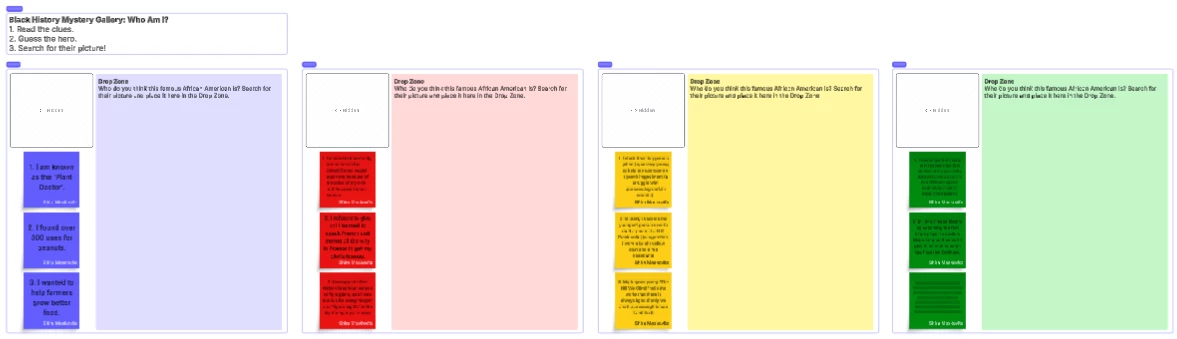
I’ve moved away from static biographies and toward a "Who Am I?" Interactive Gallery. It’s a high-energy engagement tool designed to get students moving, clicking, and thinking. Using Lucidspark, I set up a virtual gallery walk for four icons: Bessie Coleman, George Washington Carver, Amanda Gorman, and Jackie Robinson, but you can edit it for whoever you’d like to teach your students about. Each figure is hidden behind a hidden frame. Students only see a giant question mark and three sticky-note clues. It turns learning facts into solving a puzzle. Instead of being given a portrait, students use the Image Search tool to find the face that matches the story. This requires them to actually process the clues to know what they are looking for. There’s no complex planning here. It’s all about drag-and-drop, search-and-find, and the big reveal at the end of the lesson.
How to Play:
-
Clue Crawl: Students scroll through each frame and read the clues.
-
Evidence Collection: They find a photo to solve the station.
-
The Big Reveal: Once the class is finished, you unhide the frames. The board transforms from a sea of question marks into a vibrant gallery of Black excellence.
This isn’t about making students create a diagram from scratch. It’s about immersion. By turning a history lesson into a scavenger hunt, we ensure that students aren't just hearing names, they’re actively hunting for the legacy behind them.
How do you hook your students when teaching history? Let’s swap game ideas in the comments!





 Your privacy choices


