

Connecting ideas with hexagonal thinking and Lucid

  • September 26, 2025
  • 5 replies
  • 74 views

Braxton Thornley
Forum|alt.badge.img+1

Instructor Highlight | Braxton Thornley

Sr. Trainer | Instructional Technology | Utah Education Network


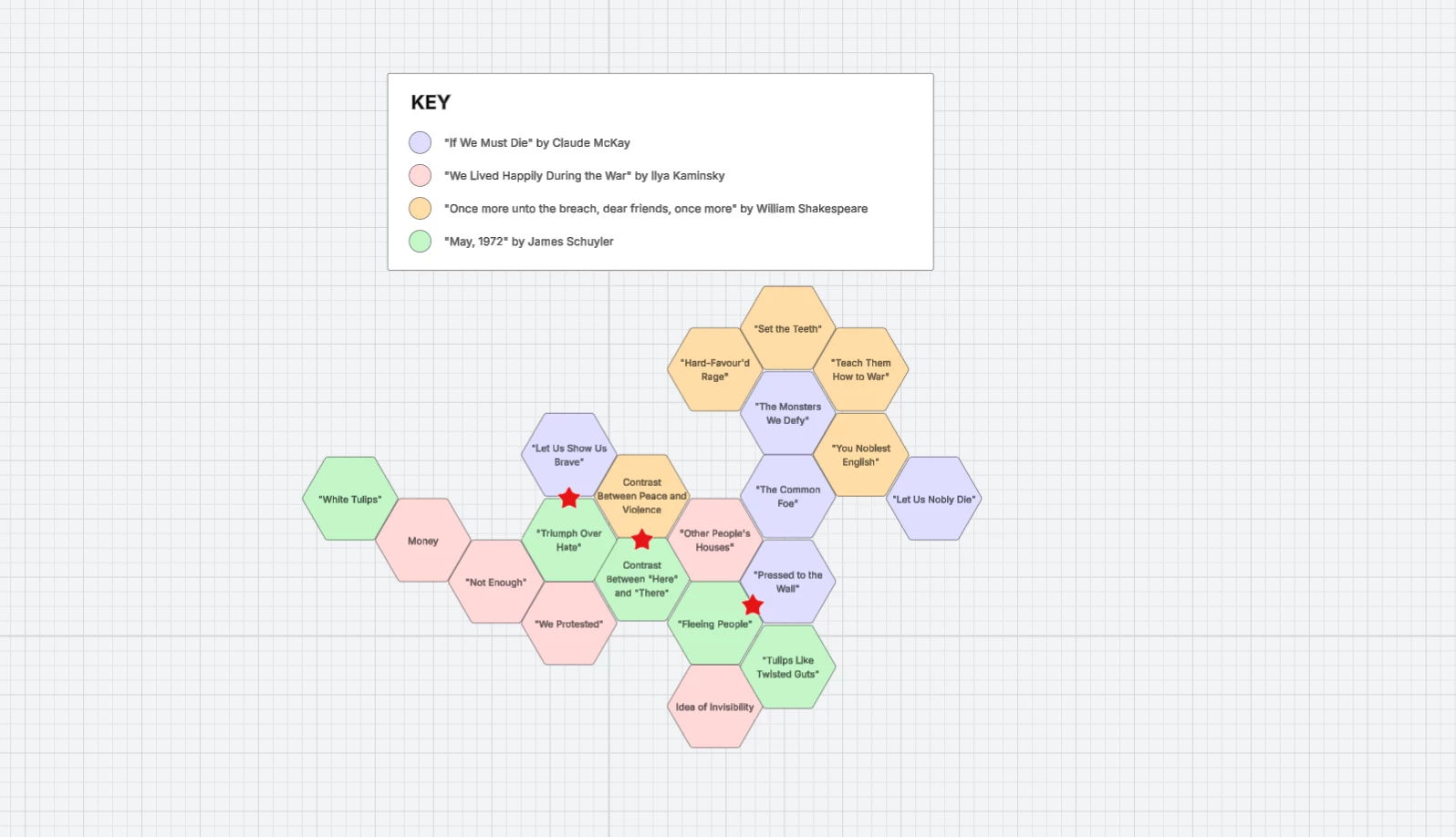
Template: Sample Hexagonal Thinking Activity (War Poetry)

Video: Connecting Ideas with Hexagonal Thinking and Lucid


Detailed Walkthrough

Classroom discussion is a powerful tool for deepening students’ learning (Hattie places its effect size at 0.82) but can be difficult to facilitate. How can we get more students to talk—and talk more deeply—about what they’re learning? One of my favorite approaches is hexagonal thinking. 

Originally developed by Betsy Potash, hexagonal thinking is a discussion-based activity requiring students to connect ideas. It works like this: students are divided into groups and given a number of hexagons (either physical or digital). Each hexagon is labeled with an idea or concept. Students then illustrate connections between ideas by lining up the side of one hexagon with the side of another.

Because hexagons have six sides, any one idea could potentially connect with six others, providing ample opportunity for students to find interesting connections they may have missed otherwise. Most importantly, though, the task itself demands enough creativity and collaboration to spark meaningful conversation. 

Here’s how I set it up:

  1. Sign into Lucidchart.
  2. Create as many hexagons as you’d like your students to tangle with, and add any other elements you think could deepen students’ conversations. (I like to ask students to designate interesting connections with stars, and when comparing concepts from different units or texts, I tend to color code the hexagons.)
  3. Convert your document into a template.
  4. Share the template link with students.

Comments

Braxton Thornley
Forum|alt.badge.img+1

It looks like I may have shared a view link rather than the template link. You can find the template link here: 

https://lucid.app/lucidchart/e33d3dd7-6581-4731-8958-55b53bd992f0/editNew?invitationId=inv_c746937d-a1af-49c0-8bc0-67df90d12a00


Vanessa C101
Forum|alt.badge.img+15
  • Lucidite
  • September 29, 2025

What a great way to encourage students to think more deeply about the topics they are studying!  Thanks for sharing :)


Ambar D
Forum|alt.badge.img+10
  • Lucid community team
  • September 29, 2025

I love this example ​@Braxton Thornley, thanks for sharing in the community! I’ve never seen a hexagonal thinking template or example in Lucid before, this is great!


charlesstanley
Lucid Legend Level 2
Forum|alt.badge.img+2
  • Lucid Legend Level 2
  • September 29, 2025

I really enjoyed your post and video. Both came across so clearly and were easy to follow. The way you broke down hexagonal thinking made the strategy feel approachable, and I can see how students would really benefit from the conversations it sparks. Your video especially stood out because it felt both practical and inviting. I could picture myself walking students through the same steps.

A potential extension of this kind of project could be giving students the opportunity to generate their own “extension hexagons.” Once they’ve worked with the original set, they might design new ones that reflect examples from their own learning, connections across units, or even ties to real-world events. This variation could broaden the template’s possibilities and open the door for even richer discussion.

I think you’ve highlighted something really powerful here, and I’d be excited to see how others adapt and expand on this approach in their own classrooms.


Stacey R
Lucid Legend Level 5
Forum|alt.badge.img+10
  • Lucid Legend Level 5
  • October 2, 2025

I love this type of visual mapping! The template and videos were so helpful, ​@Braxton Thornley .

Thanks ​@charlesstanley for the extension idea, too.