
Using Lucid templates for designing research questions
Hi everyone!
I’m new to this community and teaching both in graduate and undergraduate courses at a Canadian institution (University of Saskatchewan). I’m fairly new to teaching but have started out using Lucid for the past few years in both levels of courses. So far I’ve mostly used pre-built templates in Lucid to get started and look forward to learning from this group.
One example I use Lucid for teaching in my graduate Qualitative Research Methods course is for designing a research question using a mind map or “starburst” template I found in Lucid templates.
The students are asked to use the template and submit their output as an in class activity via Canvas (see instructions below).
The students really enjoyed using an online tool. I gave then other options if they didn’t want to work in Lucid, but everyone preferred it! The main comment was how flexible and easy to use it was and they could be creative with it. They liked the sticky notes to generate lots of ideas and questions and it helped them identify a solid research question as a first iteration.
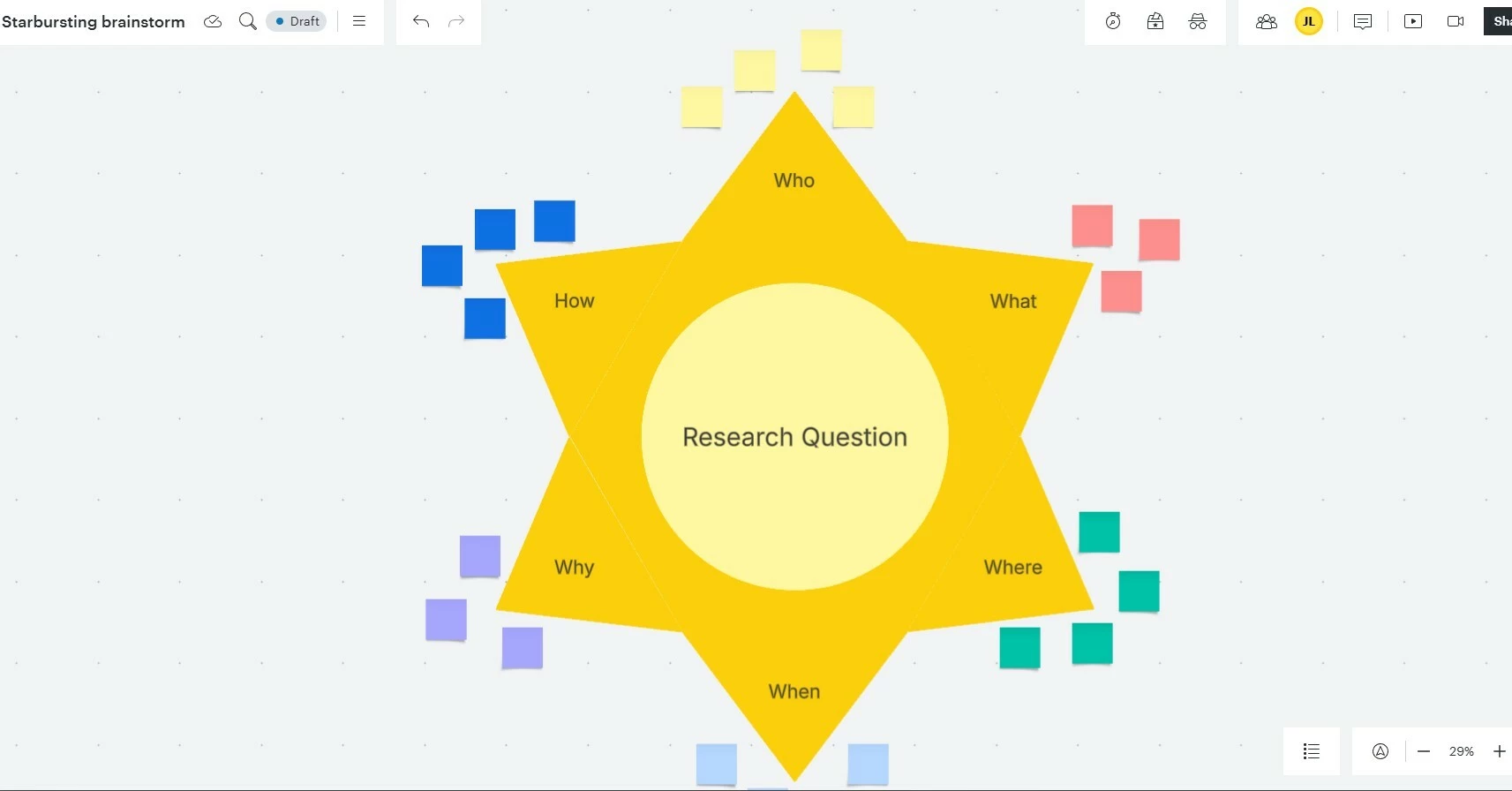
Students are provided with these instructions:
In-Class Activity: Starbursting Brainstorm - Developing Your Research Question
Purpose
Starbursting is a brainstorming technique that helps you explore a topic by asking questions instead of immediately searching for answers. By generating many different questions, you'll identify patterns, gaps, and areas that interest you most. These questions will help you narrow a broad topic into a focused research question. We are using Lucid for this activity. If you haven't already logged into Lucid, do so by clicking the Lucid (whiteboard) link in the course menu (see menu on the left).
Instructions
Please go through the steps and once complete submit your starburst Lucid mind map with your proposed research question from our in-class exercise on Canvas (submissions open until 4pm today).
A lucid template has been created for the starburst brainstorming exercise for developing a research question. You should be able to start the activity directly through this assignment and submit. If you have any trouble, you can use this link to the template. Please make a copy and rename it with your name and export to PDF to upload here. Alternatively, you can also use this word template if Lucid isn't working for you.
Step 1: Write Your Broad Topic
In the center circle labeled Research Question, write your broad topic or area of interest.
Examples:
- Artificial Intelligence
- Mental Health
- Climate Change
- Social Media
- Renewable Energy
Don't worry if it isn't a research question yet—it can simply be your topic.
Step 2: Brainstorm Questions
Using the six points of the star, write as many questions as you can on the sticky notes around each category.
Important: At this stage, do not answer the questions. Your goal is to generate curiosity.
Try to create at least 3–5 questions for each category.
Guiding Questions
Who?
Think about people, organizations, or groups.
Examples:
- Who is most affected?
- Who benefits?
- Who is responsible?
- Who studies this topic?
- Who disagrees about this issue?
What?
Think about definitions, problems, events, or ideas.
Examples:
- What causes this?
- What are the impacts?
- What solutions exist?
- What controversies surround it?
- What don't we know yet?
Where?
Consider location or setting.
Examples:
- Where is this most common?
- Where has it been studied?
- Where are the biggest challenges?
- Where are successful solutions being used?
When?
Think about time.
Examples:
- When did this become important?
- When does it occur?
- When has it changed?
- When might it become a larger issue?
Why?
Explore reasons and significance.
Examples:
- Why does this happen?
- Why is it important?
- Why should people care?
- Why is it difficult to solve?
How?
Think about processes or solutions.
Examples:
- How does it work?
- How is it measured?
- How can it be improved?
- How does it affect society?
- How could future research help?
Step 3: Look for Patterns
After you've generated your questions:
- Which questions interest you the most?
- Which questions seem connected?
- Which questions could be researched using reliable sources?
- Which questions are specific enough to investigate?
Highlight or bold your strongest ideas.
Step 4: Draft Your Research Question
Use your favorite questions to create one focused research question.
A strong research question should be:
- Specific
- Clear
- Researchable
- Open-ended (not answered with yes/no)
- Narrow enough to investigate within your assignment
Example
Topic: Social Media
Questions generated:
Who
- Who spends the most time on social media?
- Who is most vulnerable to misinformation?
What
- What are the effects of social media on attention span?
- What strategies reduce misinformation?
Where
- Where is misinformation shared most often?
When
- When are teenagers most likely to use social media?
Why
- Why do false stories spread faster than true ones?
How
- How do recommendation algorithms influence what users see?
- How does social media affect academic performance?
Possible Research Question
"How do social media recommendation algorithms influence the spread of misinformation among teenagers?"
Success Tips
- Ask lots of questions, even unusual ones.
- Don't worry about finding the "right" question immediately.
- Avoid answering questions during brainstorming.
- Use the sticky notes to organize ideas and move them if needed.
- The more questions you ask, the easier it becomes to identify a strong research question.
Before You Finish
Ask yourself:
- Did I write questions in each of the six categories?
- Did I identify the questions that interest me most?
- Can I turn those ideas into one focused research question?
This process is designed to help you move from "I have a topic" to "I have a focused, researchable question."
I always appreciate feedback or new ideas, so feel free to share other creative ways to do this.
Thanks!
Joelena
 Your privacy choices


